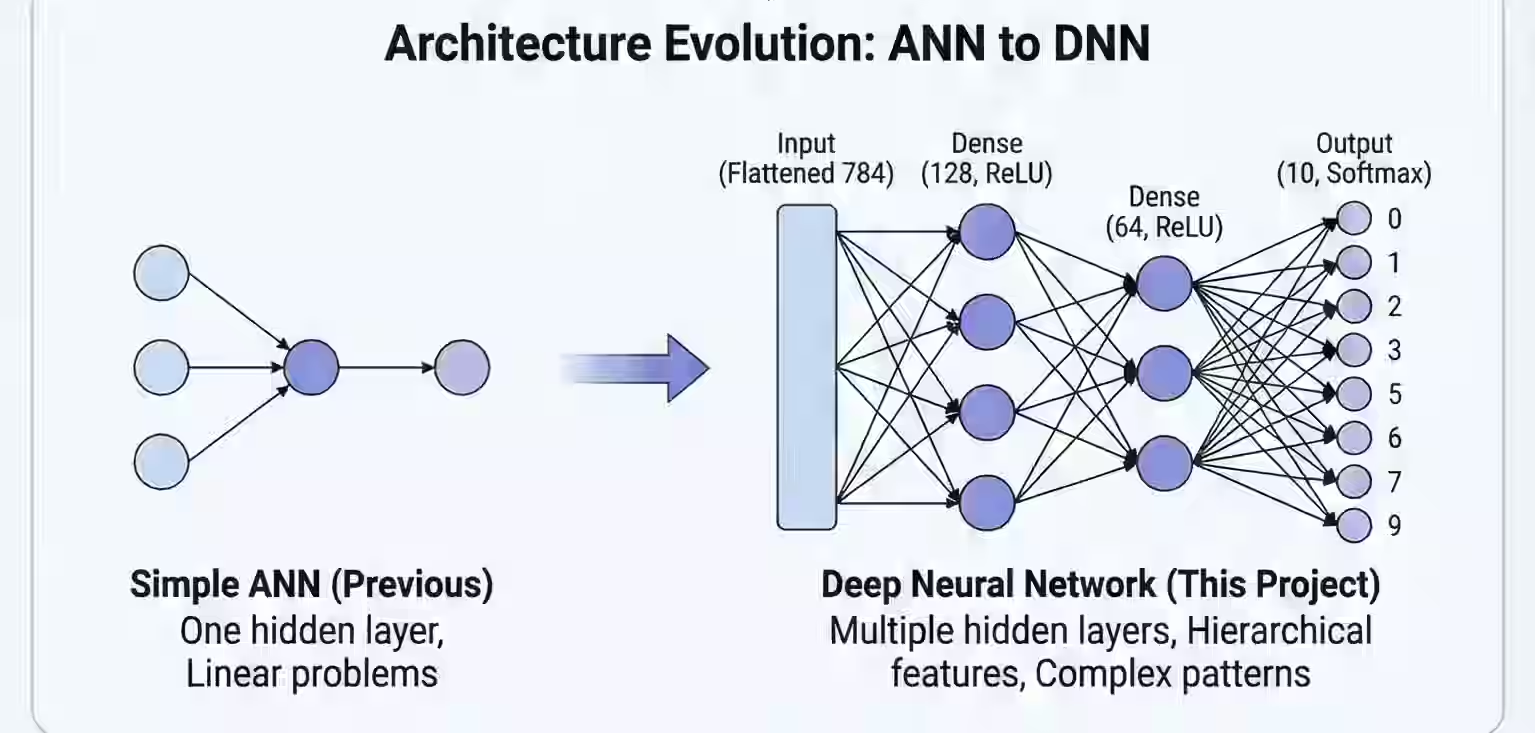
After building my first ANN to predict exam scores, I was ready for the next challenge: Deep Neural Networks. This time, instead of predicting one number, the network would recognize handwritten digits (0-9) from images!
🎯 What Makes This Different from ANN?
| ANN (Previous Project) | DNN (This Project) |
|---|---|
| Input: 1 number (hours) | Input: 784 numbers (28×28 image) |
| Output: 1 number (score) | Output: 10 classes (digits 0-9) |
| 1 layer | Multiple hidden layers |
| Linear problem | Non-linear, complex patterns |
Key insight: When problems get complex, we need depth - multiple layers that learn hierarchical features.
🖼 What is MNIST?
MNIST is the “Hello World” of machine learning - a dataset of 70,000 handwritten digit images:
- Image size: 28 × 28 pixels
- Color: Grayscale (0-255)
- Labels: Digits 0 through 9
- Training set: 60,000 images
- Test set: 10,000 images
🧠 The DNN Architecture
Here’s the model that achieves 97%+ accuracy:
model = tf.keras.Sequential([
    tf.keras.layers.Flatten(),
    tf.keras.layers.Dense(128, activation='relu'),
    tf.keras.layers.Dense(64, activation='relu'),
    tf.keras.layers.Dense(10, activation='softmax')
])
Let me break down each layer:
🔹 Layer 1: Flatten()
What it does: Converts the 2D image into a 1D vector.
Before: 28 × 28 image (matrix)
After:  784 numbers → [x1, x2, x3, ... x784]
Why needed? Dense layers expect a flat vector, not a 2D grid.
🔹 Layer 2: Dense(128, activation=‘relu’)
What it does:
- 128 neurons, each connected to ALL 784 input pixels
- Learns simple patterns (edges, curves)
ReLU activation:
output = max(0, x)Why ReLU? Adds non-linearity. Without it, stacking layers would just be linear math - no real “depth.”
🔹 Layer 3: Dense(64, activation=‘relu’)
What it does:
- 64 neurons receiving input from the 128 neurons above
- Combines simple features into complex patterns
- Learns digit-specific shapes
This is hierarchical learning - building complex understanding from simple parts!
🔹 Layer 4: Dense(10, activation=‘softmax’)
What it does:
- 10 neurons - one for each digit (0-9)
- Outputs probabilities that sum to 1.0
Example output:
[0.01, 0.02, 0.90, 0.01, 0.01, 0.02, 0.01, 0.01, 0.01, 0.00]
         ↑
    Digit 2 has 90% probability → Prediction: 2
📊 Complete Training Code
import tensorflow as tf

# 1. Load MNIST dataset
(x_train, y_train), (x_test, y_test) = tf.keras.datasets.mnist.load_data()

# 2. Normalize pixel values (VERY IMPORTANT!)
x_train = x_train / 255.0
x_test = x_test / 255.0

# 3. Build the DNN model
model = tf.keras.Sequential([
    tf.keras.layers.Flatten(input_shape=(28, 28)),
    tf.keras.layers.Dense(128, activation='relu'),
    tf.keras.layers.Dense(64, activation='relu'),
    tf.keras.layers.Dense(10, activation='softmax')
])

# 4. Compile model
model.compile(
    optimizer='adam',
    loss='sparse_categorical_crossentropy',
    metrics=['accuracy']
)

# 5. Train
model.fit(x_train, y_train, epochs=5, validation_split=0.1)

# 6. Evaluate
model.evaluate(x_test, y_test)
🤔 Questions I Asked (And Finally Understood)
Q: Why normalize pixels by dividing by 255?
Answer: Raw pixel values (0-255) are too large and vary too much. Normalizing to 0-1:
- Makes training more stable
- Helps gradients flow better
- Speeds up convergence
x_train = x_train / 255.0 # Now values are 0.0 to 1.0Q: Why use Adam instead of SGD?
Answer: Adam is “smarter” than basic SGD:
- Adaptive Moment Estimation
- Automatically adjusts learning rate per parameter
- Works well out-of-the-box
For most deep learning, Adam is the default choice!
Q: What is sparse_categorical_crossentropy?
Answer: It’s the loss function for multi-class classification with integer labels.
- Sparse = labels are integers (0, 1, 2, … 9)
- Categorical = multiple classes
- Crossentropy = measures how wrong the probability distribution is
If labels were one-hot encoded, we’d use categorical_crossentropy instead.
Q: What’s the difference between ANN and DNN?
Answer: DNN = ANN with multiple hidden layers.
| Feature | ANN | DNN |
|---|---|---|
| Hidden layers | 0-1 | 2+ ✅ |
| Neurons | Few | Many ✅ |
| Learning | Simple patterns | Complex, hierarchical ✅ |
| Use case | Linear problems | Images, text, complex data |
Key insight: All DNNs are ANNs, but not all ANNs are “deep.”
🧠 What Each Layer Learns (Hierarchical Features)
| Layer | What It Learns |
|---|---|
| Flatten | Raw pixels |
| Dense 128 | Edges, simple curves |
| Dense 64 | Digit parts (loops, lines) |
| Dense 10 | Final digit classification |
This is why deep learning works - it builds understanding layer by layer!
⚠️ Overfitting: The DNN Trap
Problem: If you add too many layers/neurons:
- Training accuracy goes UP ↑
- Test accuracy goes DOWN ↓
The model memorizes training data instead of learning patterns!
Solutions:
- Dropout: Randomly disable neurons during training
- Regularization: Penalize large weights
- Early stopping: Stop training when validation accuracy plateaus
- Less depth: Sometimes simpler is better
📈 Results
After just 5 epochs:
- Training accuracy: ~98%
- Validation accuracy: ~97%
- Test accuracy: ~97-98%
The DNN correctly classifies handwritten digits with near-human accuracy! 🎉
🚀 What I Learned (Key Takeaways)
✅ Depth matters - multiple layers learn complex patterns
✅ Flatten converts images to vectors for Dense layers
✅ ReLU adds non-linearity (essential for learning)
✅ Softmax outputs probabilities for multi-class problems
✅ Normalization is crucial for stable training
✅ Adam optimizer works better than basic SGD
✅ Overfitting is the enemy - regularize!
📁 Try It Yourself
I’ve open-sourced this project with full code and explanations:
🔗 GitHub: DNN Handwritten Digit Classification
🎯 What’s Next?
This DNN works great for simple images, but for complex images (cats, dogs, faces), we need something better: Convolutional Neural Networks (CNNs).
Stay tuned for my next project where I build a CNN to classify cats vs dogs! 🐱🐶
Questions about DNNs? Feel free to reach out - explaining concepts helps me learn too! 🧠✨